Architecture for the production AI lifecycle.
We help enterprises move AI prototypes into production, addressing cost, latency and agent security with the OpsAtScale architecture blueprint.
Why do AI initiatives stall in production?
Production AI needs coordinated decisions about model serving, data access, security, cost and operations. We assess these requirements together before scaling.
The Cost & Scaling Trap
Enterprises overpay by routing every request to massive frontier models. We solve this by adapting domain-specific models (LoRA) and implementing progressive routing to match the model size to the task complexity.
Unpredictable Inference Latency
Mixing prompt processing and text generation on the same GPUs causes contention and latency spikes. We address this by separating prefill from decode and treating KV-cache as managed, tier-based infrastructure.
The 'Rogue Agent' Risk
Autonomous agents interacting with internal tools present massive security risks. We implement a hard DevSecOps boundary using microVM isolation and deterministic verification before any state-changing actions occur.
Unmeasurable ROI
AI initiatives stall when leadership can't measure their business value. We embed AI FinOps directly into the architecture, shifting the metric from 'token volume' to 'cost per verified business outcome'.
The Multi-Plane AI Architecture.
Modern AI systems require a separation of concerns. By explicitly splitting model adaptation, distributed inference, KV-cache management, and agentic execution into distinct control planes, each layer can scale, fail, and be secured independently.
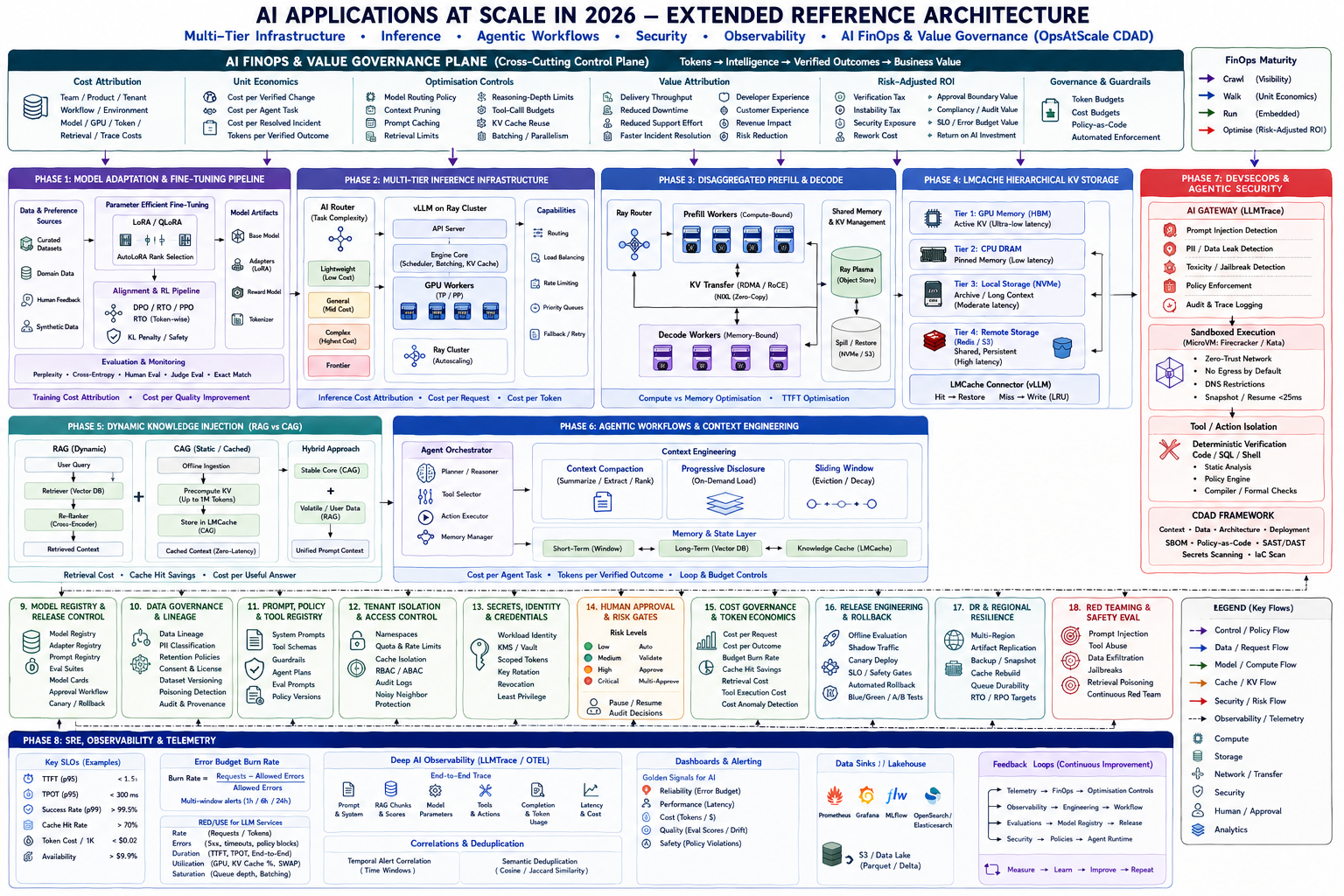
End-to-End AI Platform Engineering.
We implement the 9 phases of the OpsAtScale Enterprise Reference Architecture, establishing the operational discipline required for trustworthy AI.
Model Adaptation & Tuning
Avoid the frontier-model cost trap. Use LoRA/QLoRA to train smaller, domain-specific models that are cheaper to serve and easier to govern.
Multi-Tier Inference
Deploy a scalable inference fabric (vLLM, Ray Serve) with progressive routing. Route tasks by complexity and value, not developer preference.
Disaggregated Prefill & Decode
Solve GPU bottlenecks by separating compute-heavy prompt processing (prefill) from memory-heavy text generation (decode) to reduce contention.
KV-Cache Infrastructure
Treat context reuse as enterprise infrastructure. Use hierarchical storage across GPU HBM, CPU memory, and NVMe to reduce prefill times.
Managed Knowledge (RAG vs CAG)
Stop using RAG for everything. Use retrieval for fast-changing data, and Cache-Augmented Generation (CAG) for stable, high-reuse 'golden knowledge'.
Agentic Workflows
Enforce context discipline. Instead of open-ended chat loops, agents load minimal task packets, execute, and explicitly compact traces after each step.
DevSecOps Security Boundary
Implement hard security perimeters for agents. Isolate tool execution using microVMs and require deterministic policy-as-code verification before actuation.
Observability & Telemetry
Track request-level traceability across prompts, retrieval, tools, and policy decisions. Alert on error-budget burn and quality regressions, not just CPU spikes.
AI FinOps & Value Governance
Connect tokens to business value. Make AI spend attributable by workflow and team, optimising for 'cost per successful task' rather than raw usage.
Who needs a structured AI lifecycle?
We partner with leadership and engineering teams to build robust infrastructure that delivers predictable value.
Platform & Cloud Leadership
- ·Escape vendor lock-in by standardizing the AI lifecycle on an open, multi-plane architecture.
- ·Control runaway inference costs with cache-aware routing and FinOps value governance.
- ·Ensure regulatory compliance (NIST AI RMF, NCSC) with deterministic agent security boundaries.
AI Engineering & Operations
- ·Eliminate GPU contention by separating prefill and decode worker pools.
- ·Deploy domain-tuned LoRA models alongside foundation models with progressive routing.
- ·Debug complex agent failures with semantic OpenTelemetry tracing and step-level lineage.
Adopt the Lifecycle Architecture.
Bring the OpsAtScale blueprint into your organisation with Setloop’s implementation expertise.