Launch, scale, and monetise GPU workloads on one platform.
GPU Cloud is the product offer for companies that want to turn GPU capacity into a secure, governed, revenue-ready platform.
Turn GPU capacity into services customers can use.
The platform combines customer access, secure tenancy, workload orchestration, cost-aware autoscaling, billing, and recoverable storage so GPU services can be offered commercially and operated confidently.
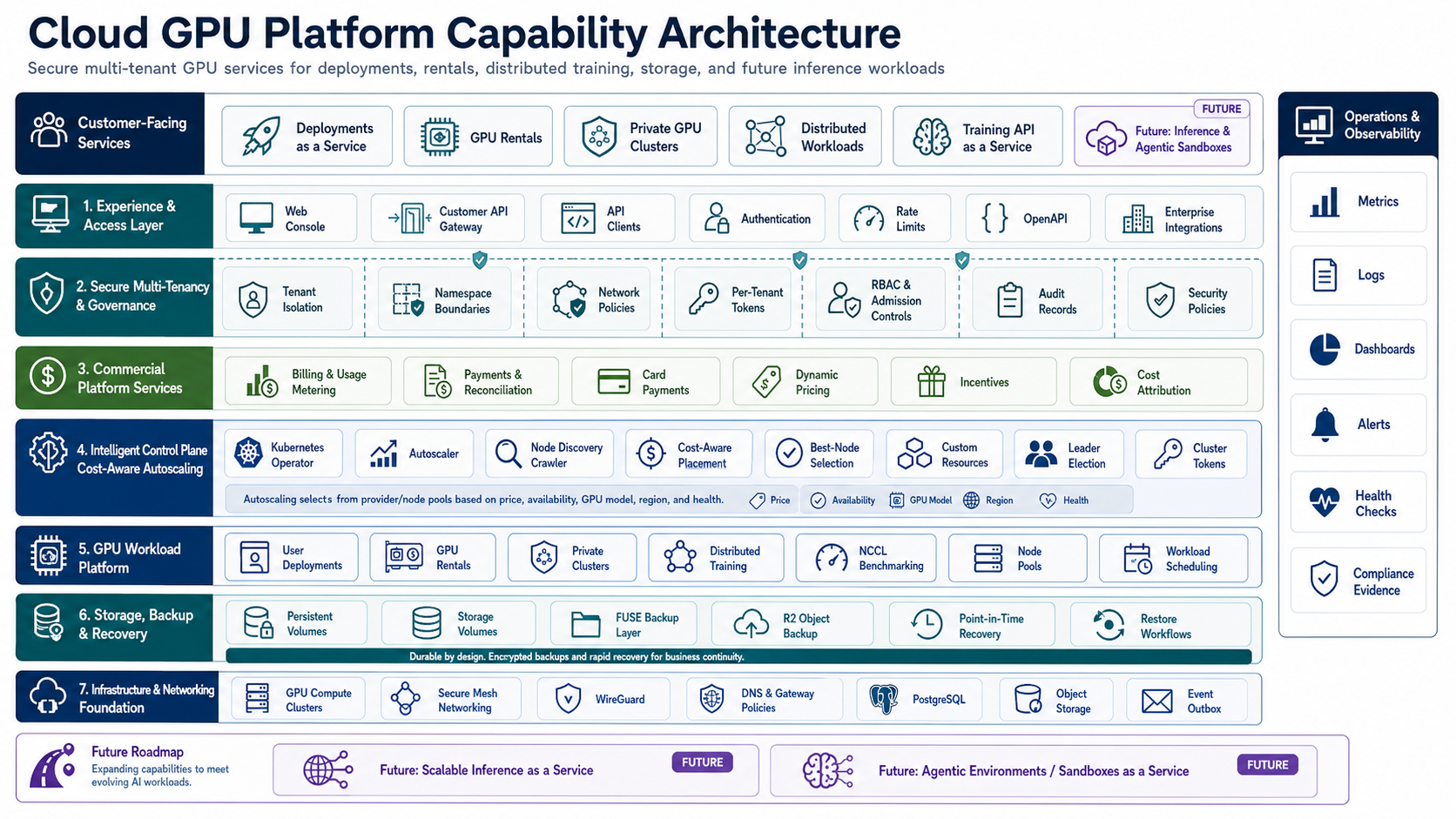
GPU services for the AI workload lifecycle.
The product can expose multiple commercial services while the platform handles placement, governance, billing, operations, and recovery behind the scenes.
Deployments as a Service
Customers submit workload definitions and the platform provisions runtime environments, networking, gateway policy, tokens, and storage.
GPU Rentals
Expose GPU capacity as schedulable rental inventory with metered usage, price attribution, billing events, and operator visibility.
Private GPU Clusters
Provide isolated GPU capacity for enterprise customers with tenant-scoped access, network separation, and policy boundaries.
Distributed Workloads
Coordinate multi-node jobs with cluster-aware scheduling, secure mesh networking, rank assignment, and benchmark validation.
Training API as a Service
Turn distributed training into a programmable service where users bring code and data while the platform manages placement and recovery.
Inference and Sandboxes
Extend the same control plane into scalable inference endpoints and governed agentic environments as the platform matures.
What customers can buy and operate through the platform.
Offer multiple GPU services through a shared control plane for access, scheduling and billing.
GPU rental customer
- 01Select GPU class, region, duration, and access mode.
- 02Receive scoped credentials and tenant-isolated capacity.
- 03Usage is metered and attributed to the correct account.
- 04Operators see health, utilisation, cost, and support signals.
Deployment customer
- 01Submit workload definition through API or console.
- 02Platform provisions runtime, network policy, gateway rules, tokens, and storage.
- 03Autoscaler places the workload on suitable GPU supply.
- 04Customer sees status, logs, usage, and recovery options.
Enterprise private cluster customer
- 01Dedicated or logically isolated capacity is allocated.
- 02Network boundaries, access controls, and policy rules are applied.
- 03Usage, audit, and cost records remain tenant-scoped.
- 04The platform can support sensitive workloads without ad hoc operations.
Distributed training customer
- 01User provides training code, environment, and data paths.
- 02Platform handles multi-node scheduling, rank assignment, and rendezvous.
- 03Benchmarks validate network and GPU readiness.
- 04Checkpoints and storage recovery reduce long-run failure risk.
One consistent platform model.
Every layer is designed as a service boundary with clear ownership, security controls, and operating signals.
Experience & Access
Web console, customer API gateway, authentication, and OpenAPI integrations.
Secure Multi-Tenancy
Namespace boundaries, network policy, per-tenant tokens, RBAC, admission controls, and audit records.
Commercial Services
Billing, usage, payments, reconciliation, and cost attribution by tenant, workload, cluster, and service.
Intelligent Control Plane
Operator, autoscaler, node discovery crawler, and best-node selection across price, model, region, health, and supply.
GPU Workload Platform
User deployments, private clusters, distributed training jobs, and NCCL benchmark visibility.
Storage & Recovery
Persistent volumes, FUSE-backed object backup, S3-compatible storage, and restore workflows.
Tools for operators and customers.
Customer access, workload orchestration and billing tools support day-to-day platform operations.
Customer API Gateway
One programmable entry point for deployment requests, account actions, usage visibility, and enterprise integrations.
Billing & Usage
Transforms workload consumption into traceable billing records with cost attribution across tenants, services, jobs, and clusters.
Payments & Reconciliation
Connects wallet balances, card payments, deposits, settlement logic, and billing events so the platform can operate commercially.
Kubernetes Operator
Turns product-level workload intent into secure cluster resources and continuously reconciles desired state.
Node Discovery Crawler
Searches available GPU supply and feeds the autoscaler with current price, capacity, region, GPU model, and health data.
Best-Node Selection
Ranks candidate nodes by price, GPU class, region, health, availability, tenant constraints, and workload objective.
Secure Mesh Networking
Creates private workload connectivity with WireGuard-style mesh links, reachability checks, DNS, and gateway policy controls.
Distributed Training
Packages multi-node orchestration, environment setup, scheduling, rendezvous, and benchmark visibility into a service-ready product.
Recoverable Volumes
Protects workload data with persistent volumes, FUSE-backed object backup, S3-compatible storage, and restore workflows.
Security, economics, and recovery are platform capabilities.
A GPU cloud product needs more than scheduling. It needs tenancy, cost control, backup, observability, and evidence that operators can support.
Secure multi-tenancy
- ·Tenant workloads run within scoped namespace boundaries.
- ·RBAC and admission controls enforce what can be deployed.
- ·Network policies and secure mesh rules limit lateral movement.
- ·Per-tenant tokens separate API, cluster, and deployment access.
- ·Audit records provide evidence for operational review.
Cost-aware autoscaling
- ·The node discovery crawler continuously inspects available GPU supply.
- ·Placement considers price, GPU model, region, availability, and health.
- ·Provider and node-pool options are normalised for fair comparison.
- ·Scheduling policies balance service quality against infrastructure cost.
- ·Failed or degraded offerings are tracked to avoid repeat bad placements.
Storage backup and recovery
- ·Persistent volumes keep workload state attached to deployments.
- ·A FUSE backup layer can mirror filesystem data to object storage.
- ·Backups are designed around durable, S3-compatible object storage.
- ·Restore workflows recover volumes after failure or migration.
- ·Audit and event records support traceability for data operations.
Operational visibility
- ·Metrics expose control plane, workload, and service behaviour.
- ·Logs and dashboards support incident response and customer support.
- ·Alerts highlight health, leadership, usage, and capacity issues.
- ·Benchmark results validate distributed workload readiness.
- ·Audit and telemetry records support compliance evidence.
Move from GPU inventory to GPU product.
The consulting engagement turns raw capacity and operating constraints into a launchable product architecture.
A foundation for the next GPU-backed services.
The same secure multi-tenant control plane can expand into scalable inference, governed agentic environments, and additional enterprise AI services.
Scalable Inference as a Service
Serve models behind managed endpoints with autoscaling GPU capacity, metered usage, tenant isolation, rate limits, and operational observability from day one.
Agentic Environments as a Service
Provide secure sandboxes for AI agents to execute tasks, access tools, use GPUs, and run inside governed tenant boundaries.
Design your GPU Cloud product.
For datacentre operators, GPU cloud providers, AI infrastructure startups, and enterprises bringing GPU capacity to internal or external customers.