Autonomous RL experiment loops for long-running research.
Automatic RL Research helps teams automate model experimentation: propose the next run, train, evaluate, keep what works, redeploy winning models under guardrails, discard what does not, and continue with evidence.
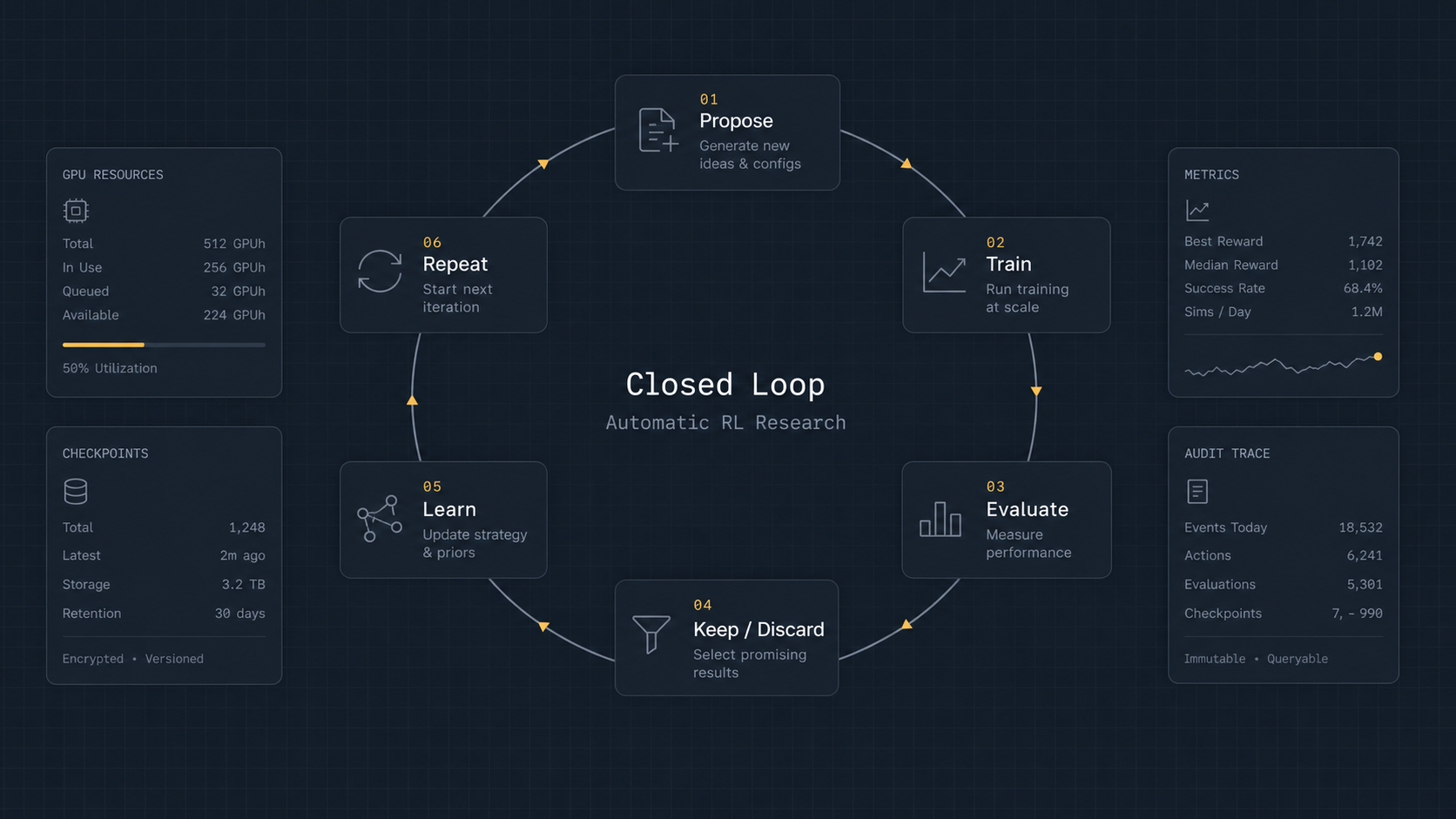
Turn model research into a controlled optimisation loop.
Manual experiment tracking does not scale when teams need repeated training, reward-function iteration, objective evaluation, and safe model rollout. Automatic RL Research provides a campaign runner for continuous model improvement with explicit stop guards, regression gates, resumable state, traceable outcomes, and controlled redeployment of winning models.
Experiment, evaluate, redeploy
An LLM proposes hyperparameters or code changes, runs training, evaluates the result, keeps what improves, and can promote the winning model into a controlled serving path.
Frozen evaluation, mutable training
The evaluation script defines what is correct and stays frozen. The training script evolves the approach without changing the scoring rules.
Local, API, or cloud GPU targets
The same campaign configuration can run locally, against a remote HTTP target, or on cloud GPU infrastructure.
Regression and reward-gaming protection
Frozen scorers, held-out evaluations, required-call validation, canary checks, and rollback controls help prevent regressions or agents gaming the reward.
A research loop with deployment and safety guardrails.
The service separates the evaluation definition from the mutable training strategy, with controls designed to detect reward gaming and regressions as agents modify the training method.
Prepare the evaluation boundary
A frozen preparation script creates the data and scoring protocol. This protects evaluation integrity.
Run mutable training iterations
A training script runs each iteration, writes metrics, and can be changed by policy when improvement stalls.
Choose the next experiment
Policies select parameters, code diffs, or learned actions using the full campaign history.
Promote, redeploy, and continue
Improving runs are versioned, guarded against regression, promoted only when they beat the incumbent, and can be redeployed while the campaign continues.
Two applied research tracks from the same loop.
Setloop adapts the research loop to model training, representation learning and inference optimisation programmes.
AutoJEPA
Autonomous JEPA pretraining search
A specialised extension of the closed-loop research pattern for self-supervised JEPA pretraining. It keeps the evaluation boundary frozen, lets training recipes evolve, and uses probe-based evaluation plus collapse gates to decide which representation-learning runs survive.
AutoInfer
Inference optimisation search
A closed-loop optimisation system for serving models at the right operating point. It searches engine configuration, hardware topology, and kernel implementation choices against throughput, memory, context length, quality, and tokens-per-dollar.
Built for GPU-backed experimentation campaigns.
Automatic RL Research complements Setloop's GPU Cloud, AI SRE, and AI architecture work by giving model teams a repeatable way to run, evaluate, promote, and redeploy training campaigns safely.
LLM-guided search
Use grid, random, LLM-guided, diff-based, hybrid, or learned policies to decide the next experiment.
Code-diff improvement
When tuning stalls, the system can propose validated code diffs to improve reward shaping, training strategy, or generation logic.
Guarded promotion
Winning models can be versioned, promoted, and redeployed behind canary checks, with rollback available when live metrics regress.
Anti-gaming controls
Frozen evaluation files, unreachable scorers, held-out test sets, and required-call validation stop the agent from redefining success or bypassing the real reward path.
Checkpoint and resume
Campaign state is persisted after each iteration so long-running research loops survive interruptions and restarts.
Comparable results
Per-iteration scores, comparability metadata, kept versions, and structured traces make experiment history reviewable.
Model persistence
Best models and version metadata can be captured for inspection, internal release, registry upload, and production redeployment workflows.
Progress visibility
Structured output and progress charts help teams see which experiments moved the score and which were discarded.
Where Automatic RL Research fits.
Use it when the value comes from repeated, measurable improvement rather than a single training run.
Design the loop around your research goals.
Setloop delivers Automatic RL Research as a bespoke consultancy service: we define the evaluation boundary, campaign policy, GPU execution model, evidence trail, redeployment path, regression gates, anti-gaming controls, and operational controls around your model programme.